

Misleading Information and Clickbait
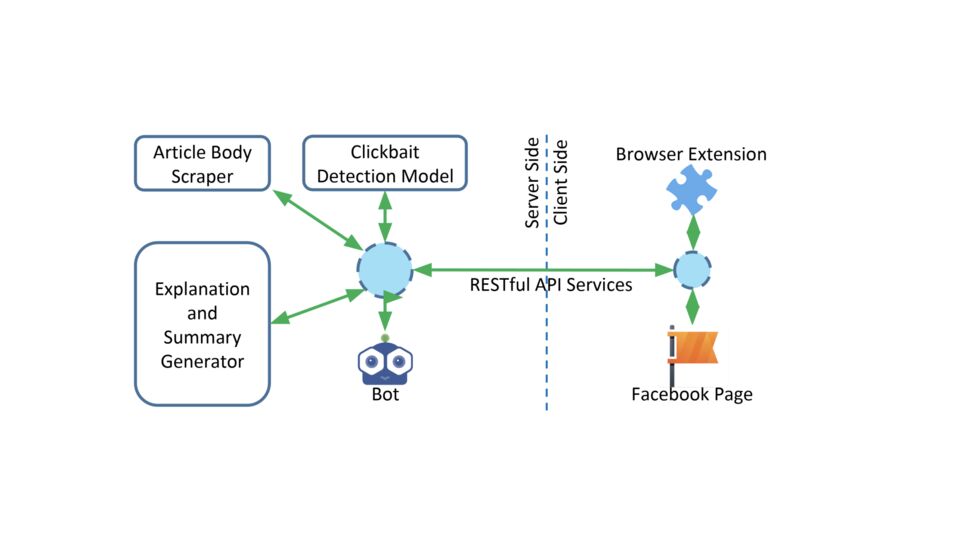
Much of the most consequential misinformation is not an outright lie. Misleading headlines and clickbait are hard for people to spot and common in both mainstream and unreliable outlets. Drawing on journalism and information studies, we built a taxonomy of the tactics they use and BaitBuster, a tool that flags misleading posts while people browse social media.
In BaitBuster 2.0, an NSF-funded collaboration, we turned to video. We curated a dataset of misleading video headlines with a multi-layered question-answering annotation strategy and built multimodal models that identify misleading videos with 88% accuracy. Current work tests how corrected headlines affect credibility and engagement, and whether large language models can identify and explain misleading tactics.

Publications
-
ASONAM 2025
Can Honest Headlines Engage? Correcting Misleading Headlines to Improve Credibility, Comprehension, and Engagement
International Conference on Advances in Social Networks Analysis and Mining
-
C+J 2025
Between Consensus and Ambiguity: Expert Evaluation of LLM Explanations for Misleading Headlines
Computation + Journalism Symposium 2025
-
CHI HEAL 2024
Exploring the Potential of the Large Language Models (LLMs) in Identifying Misleading News Headlines
CHI 2024 Workshop on Human-centered Evaluation and Auditing of Language Models (HEAL)
-
EMNLP 2023
Not all fake news is written: A dataset and analysis of misleading video headlines
Proceedings of the 2023 Conference on Empirical Methods in Natural Language Processing
-
CHI 2021
Does Clickbait Actually Attract More Clicks? Three Clickbait Studies You Must Read
Proceedings of the 2021 CHI Conference on Human Factors in Computing Systems
-
AEJMC 2020
Varying amounts of information in health news headlines can affect user selection and interactivity
Association for Education in Journalism and Mass Communication (AEJMC)
-
arXiv 2019
Examining the Role of Clickbait Headlines to Engage Readers with Reliable Health-related Information
arXiv preprint arXiv:1911.11214